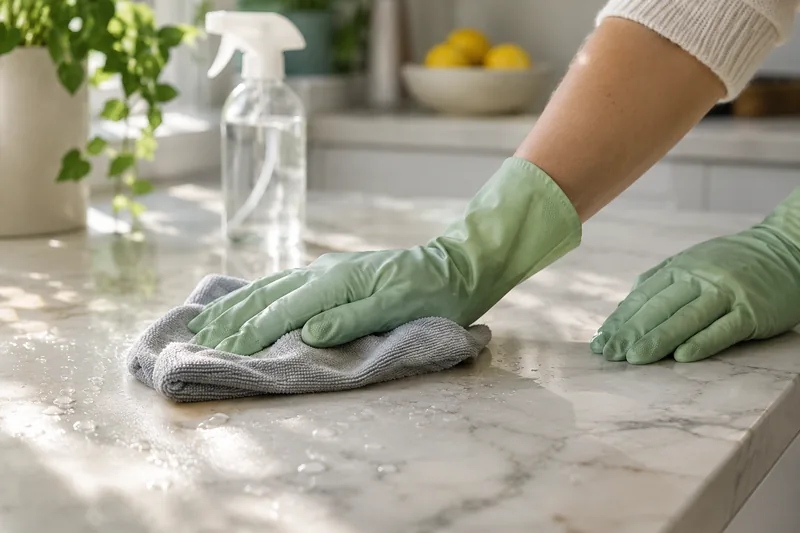
Deep cleaning

Cleaning in Calahonda
Cleaning in Calahonda, where we are based: 6,155 homes across 140 communities, four decades of building, and the hardest water on this coast.
Four decades of building behind one postcode
The urbanisation publishes its own figures, and they are worth knowing before anybody quotes a clean here. 6,155 dwellings. Around 140 sub-communities. Three million square metres, with thirty kilometres of road and pavement through it.
The number that changes the work is the one nobody publishes. Calahonda went up in phases and never came back to level them. Flat-roofed bungalows and courtyard houses from the seventies still line the original avenue. Cream render and brown tile arrived in three and four-storey blocks around the shared pools through the eighties and nineties. Hillside villas came after, and kept coming. Two front doors a hundred metres apart can be forty years apart in age, and a bathroom tiled in 1976 wants different treatment from one fitted last spring.
That is why we look at the property rather than the postcode. It is also why the first visit runs long: somebody is opening cupboards to see what is actually in there.
Who you ask about the water
Every owner belongs to the Entidad Urbanística de Conservación by law, and its levy arrives as a second bill on top of the community fee. Buyers budget for one and get two.
For us it answers a simpler question: which community a street sits in, who keeps the gate codes, and what has happened to the supply this week. When a barrier number changes, that is where it changed, and it is why we would rather be told than discover it at eight in the morning with a van waiting.
The tank above the top streets
Water reaches this urbanisation through six reservoirs and several pumping stations inside its own boundary, so the supply is a local piece of machinery rather than something piped in from elsewhere. One of those tanks, the 900 cubic metre chamber serving the upper streets, is being replaced at a cost of just over a million euros because it has fissures and sits on unstable ground. Two smaller chambers, one of 150 cubic metres and one of 100, are already out of service.
Which makes the cuts ordinary rather than dramatic. Acosol has turned off Calle Monte Paraíso, parts of Calle Jaén and Calle Córdoba, and everything south of Avenida de España, between eight and two on a single day, for routine repair work. So the water is not a constant here, and a morning booked around a bathroom is worth checking against the notice board. That is a five-minute call before the visit rather than an apology during it.
Two Calahondas, and a barrier between them
There is an upper Calahonda and a beach-side one, and they are not the same journey. The AP-7 has its own toll barrier with direct access into the streets above; the untolled A-7 runs along the bottom. Both get called Calahonda, both appear in the same listings, and one is a short hop from the office while the other is a proper drive with a barrier in the middle of it.
Above the coast road the houses climb towards El Soto and La Mairena. Those are not somewhere you pass on the way to something else, so they go in the diary as their own visit rather than being squeezed between two others.
What the water leaves behind
The supply is exceptionally hard. The Mijas Golf network measured 454 milligrams of calcium carbonate per litre, which is about as hard as it gets around here. That is the chalk ring around a tap, the clouding that climbs a shower screen from the bottom, the crust inside a kettle that rinsing will not shift.
Vinegar and time lift all three. Left to sit, the acid softens the deposit so it wipes off and the glass survives. Something aggressive is faster and takes the coating with the scale. The rest of what goes in the van is eco-friendly and comes off the shelf at the Mercadona or the Lidl.
Old blocks, old drains
Until 1984 the urbanisation treated its own waste water in small plants at the foot of each stream. Then it joined the coast-wide system. What survived from that era is a set of drains built to a different standard, and on older property the two things that go wrong are run-off after an autumn storm and the retaining walls holding up hillside plots.
Christian runs the end-of-tenancy visits for exactly this reason. Sockets that have worked loose. Isolating valves broken under a sink. A drain that has stopped running away. He knows plumbing, electrics and drains, and he will tell you what he found rather than clean around it and leave you to discover it later.
Booking a clean in Calahonda
The rate is hourly, between €21 and €26, with €25 taken before a first attendance and mentioned when you book rather than afterwards. Insured, breakages covered, anything missed done again.
What matters more than the price here is knowing which community you are in. Somebody has to be told which barrier, which key, which side of the A-7, and whether the water is off that morning. Once that is on paper the visit runs itself, which is the whole reason we write it down the first time.
A service worth knowing about
Deep cleaning in Calahonda
Local area
Where Calahonda is
Calahonda sits on the coast road, inside the run this business works from Calahonda.
Get this cleaned
Arrange a clean in Calahonda
- Form or phone, whichever suits
- Price agreed before anyone travels
- Run from Calahonda
Form or phone
Speak to us now